Practice
According to the State Educational Standard of Higher Professional Education of the Kyrgyz Republic, internships are an important component of any educational program, providing students with the opportunity to gain practical experience in their chosen field of study, enabling them to apply theoretical knowledge in real-life situations, and helping them develop the skills and competencies necessary for their future careers.
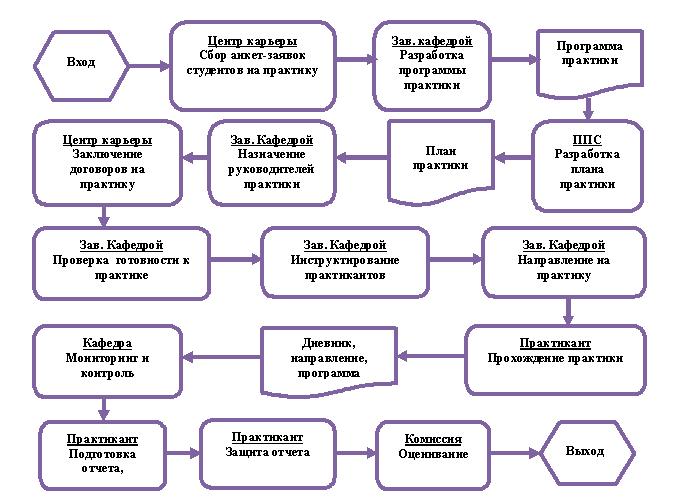
The main types of internships are: educational and industrial. Educational and industrial internships are conducted in specialized organizations of any legal form, depending on the subject's field of study.
Objectives of the educational practice:
- Consolidation of theoretical knowledge, acquisition and development of primary professional skills and practical abilities;
- To develop students' understanding of the range of work activities performed by specialized organizations in their chosen professional field.
Objectives of the educational practice:
- Developing a range of professional abilities and skills such as communication, teamwork, problem solving and time management.
- Gain practical experience in using tools and technologies related to their field of study and learn to apply theoretical knowledge to practical situations.
Objectives of industrial practice:
- Formation of professional skills;
- Gaining experience in professional activities, organizational, educational and other types of work.
Objectives of industrial practice:
- Providing students with the opportunity to develop professional skills and gain experience in various types of professional activities, including organizational, educational and other types of work,
- Applying acquired knowledge and skills to real-world situations such as project management, quality control, and teamwork helps develop practical skills and become more familiar with the tools and technologies used in their field of expertise.
Industrial practice may include several subspecies:
- practice in the field of study;
- pedagogical practice, scientific and pedagogical;
- pre-qualification (pre-graduation) practice;
- research practice.
Internship in the field of studyprovides students with an introduction to the real processes and procedures used in their chosen industry or profession, the acquisition of practical skills, and the consolidation of theoretical knowledge acquired during training, which is necessary for successful work in their chosen field.
Teaching practiceis a vital component of teacher education programs where students have the opportunity to apply the pedagogical theory they have learned in a practical setting and shapes the development of professional competencies such as: communication skills, the ability to organize and plan educational activities, diagnostic skills for assessing the needs and progress of students, as well as constructive skills for developing effective teaching and learning strategies.
Pre-qualification (pre-graduation) practiceIt is carried out after students have mastered the theoretical and practical training program as the final stage, during which material is collected for completing the final qualifying work and knowledge and skills are demonstrated for solving problems necessary for a future career.
Scientific and pedagogical (industrial) practice (SPP)The program is aimed at providing master's degree students with experience in implementing a comprehensive educational process; conducting a comprehensive analysis of scientific, pedagogical, and methodological experience in a specific subject area; designing individual components of the educational process; evaluating individual elements of the methodological teaching system; organizing and conducting a pedagogical experiment; testing various systems for diagnosing the quality of education; and implementing innovative educational technologies.
Teaching internships are an important component of many training programs. The primary goal of this type of internship is to provide students with practical experience in developing and delivering educational programs and conducting research in educational methods and technologies. During their teaching internships, students, depending on their level of education (master's or doctoral), work in various educational institutions, including specialized schools and specific departments of vocational education institutions. They focus on a specific subject area or topic. This topic involves a range of activities, including a comprehensive analysis of scientific, pedagogical, and methodological experience in a specific subject area, the design of educational programs and components of the educational process, pedagogical experiments, and the assessment of the quality of various educational systems. During this internship, students learn to substantiate the pedagogical conditions necessary to ensure the quality of educational programs, gain experience in the use, development, and implementation of innovative educational technologies and effective teaching methods, and conduct research in educational practices and methods.